

*Gian Luigi Gianfranceschi
Lo studio descrive la ricerca di molecole biologicamente attive nei germogli di grano. In particolare l’analisi di spettrometria di massa di frazioni di estratti di germogli di grano purificate mediante HPLC rileva due peptidi con [MH+] = 572 e 541, rispettivamente. Tali peptidi vengono sequenziali e sintetizzati. Le strutture proposte mostrano due pentapeptidi con N- e C-terminali bloccati e una cisteina fortemente reattiva . La possibile attività biologica dei peptidi isolati indica la regolazione redox di proteine intracellulari funzionali.
Abstract
The study describes the search for biologically active molecules in wheat sprouts. In particular, mass spectrometry analysis of fractions of wheat sprout extracts purified by HPLC shows two peptides with [MH+] = 572 and 541, respectively. These peptides were sequenced and synthesized. The proposed structures show two pentapeptides with blocked N- and C-terminals and a highly reactive cysteine. The potential biological activity of the isolated peptides suggests a redox regulation of functional intracellular proteins.
INTRODUCTION
In recent decades increasing researches on the functional properties of natural compounds have been reported (1,2). Among the various classes of active compounds, proteins and peptides are of considerable interest. In particular peptides and proteins are studied for potential models of pharmacological and nutraceuticals active molecules. This is prompted by the high degree of biodiversity of peptides and proteins, linked to amino acid sequences and structure (3). The peptide biodiversity is also increased by the peptide structure flexibility (4). Accordingly the peptides show various activities including antiproliferative, antihypertensive, antimicrobial, antioxidant, anticholesterometic , opiomid and antidiabetic activities.
A number of biochemical requirements must be met to give nutraceutical efficacy to low molecular weight peptides. Biochemical requirements of bioactive peptides for nutraceutical efficacy have been described (5).
The peptide structure may be stabilized in one or some specific conformations by the binding with specific ligands ( 6).
However the biological and therapeutical properties of peptides can be quenched or modified by their low bioavailability. Three main factors can influence peptide bioavailability in vivo : a) The peptide structure can be degraded by exo and endopeptidase. Interestingly we ( 7 ) and other (8) laboratories demonstrated that blocked N- and C-terminals are able to protect the structure from proteolitic digestion.
b)Many peptide structures are poorly permeable to cell membrane. The binding to peptide N-terminal of cell-permeable motifs has been reported .
c)Oligopeptides can be quickly eliminated by kidney functions ( 9).
In this context as a research group at the Universities of Camerino and Perugia, we reported that peptide molecules present in animal and vegetal tissues are responsible of specific biological activities including the control of gene expression and cell proliferation in cancer cells in vitro (10-14). Subsequently we observed that aqueous wheat sprouts extract exerts potent antioxidant and antinflammatory activity (15-16). Experiments performed on the cataract of old dogs showed that the daily assumption of 3 g of wheat sprout powder for 30 days significantly reduces the lens opacity (from 25 to 40%) . This is in agreement with data reported in the international literature according to which the cataract is caused by cross linking between the lens proteins due to oxidative process (17).
Moreover the effect of wheat sprout extract on NO production in RAW264.7 cells induced by Lipopolysaccharide (LPS) was tested and compared with that of an anti-inflammatory drug of common use, which is the Diclofenac (DCF). The obtained results demonstrate that the inhibition shown from the extract at the concentration 1mg/ml is almost comparable to that of the DCF 50 µg / ml, while the extract concentration of 5 mg/ml has an effect absolutely comparable to that performed by the DCF 100 µg /ml . Considering that DCF is a pure molecule while the extract contains a mixture of molecules, the anti-inflammatory effect of wheat sprouts seems really remarkable. Interestingly the extract at the concentrations utilized is not cytotoxic, on the contrary diclofenac (100 micrograms / ml) shows a cytotoxicity of about 30 % (18). In addition a preliminary clinical experimentation on the endothelial function in moderately hyperlipidemic patients demonstrated that wheat sprout administration does not significantly modify the lipid levels; only triglycerides and cholesterol LDL levels are slightly decreased. Vice versa the treatment with wheat sprout powder causes a significant increase of flux mediated vasoactivity (VFM , +38%) with a parallel decrease of some biochemical markers of endothelial dysfunction (“intercellular adhesion molecules“ ICAM, -35%) (19).
The activity of wheat sprouts extract is usually titred by some tests : a) superoxide ion radical scavenging; b) inhibition of TBARS production (thiobarbituric acid reactive substance); c) titration of ROS (oxygen reactive species) in HuDa cells ( Human dermal cell line) and Hep G2 cells (human liver carcinoma cell line) ; d) antinflammatory activity in Raw 264.7 cells induced by Lipopolysaccharide .
The strong antioxidant activity exerted by the extract is for 70% due to antioxidant peptides. The structure of the peptides extracted from wheat sprouts and fractionated by HPLC was analyzed by mass spectrometry .
Within the range of possible biological activities exerted by peptides the tripeptides AcGly–Phe–Asn(OH) and AcGly–Phe–Asn(NH2) have been tested in vitro for their antiproliferative activity on human breast adenocarcinoma cells (MDA-MB 231) and human dermal fibroblasts (HuDe) (20).The results show that these peptides significantly affect the proliferation of MDA-MB 231 and HuDe cells in different manner indicating that C-terminal amidation plays a critical role.
In the framework of research developed to isolate and characterize active molecules present in wheat sprout extracts, some low molecular weight active peptides have been isolated (21-22).
Along this research line, in 2006 we organized a conference in Castelplanio (An) at the Abbey of San Benedetto de’Frondigliosi (Fig.1) to discuss prospects and possible applications of these studies.
In this paper we report the isolation of two pentapeptides from wheat sprouts and the protection carried out by the blocked N- and C-terminals against hydrolysis by proteolytic enzymes. Moreover the potential mechanism of their biological activity is provided .
EXPERIMENTAL PROCEDURES
Preparation of wheat sprout extract
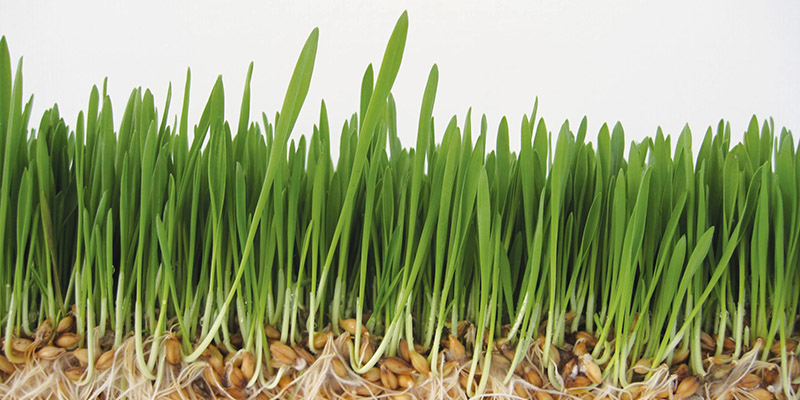
The wheat seeds sprouted for 3-5 days on soft agar (0.8-1%) (Fig.2) are dehydrated and the sprouts mechanically separated from the seeds and finely ground (see “Il germoglio di grano : un meraviglioso laboratorio naturale” Natural 1 ,Giugno2004, pag .48-53) . Wheat sprout powder extract is prepared by suspending 20 g of powder in 400 ml of water/ethanol (30:70, v/v). The mixture was homogenized by means of a Waring Blendor and centrifuged at 10000g for 30 min at 4°C. After storage at -20°C overnight, the extract was again centrifuged at 10000 g for 30 min at 4°C. The ethanol was then removed by evaporation and the aqueous residue freeze-dried.
HPLC RP analysis of wheat sprout extract
The hydroalcoholic extract of wheat sprouts is fractionated by HPLC using a semipreparative column C18 (150 mm x 10mm) (Phenomenex, Torrance, CA, USA).
The column was balanced with 0.1 % trifluoroacetic acid/acetonitrile (97:3, v/v). After 6 minutes of isocratic elution, a gradient from 3 to 20% acetonitrile was applied in 50 min. Flow rate 2.5 ml/min. About 25 fractions were isolated.
Analysis by mass spectrometry of HPLC fractions obtained from wheat sprout extract
The fractions obtained from HPLC, freeze-dried, were solubilized in methanol and injected for electrospray mass spectrometry analysis: LCQMS THERMOQUEST/
ESI-ION TRAP mass spectrometer, capillary temperature 220°C, capillary voltage 10 V, spray voltage 4kV, collision energy 17 to 23 keV.
The main ions detected by the mass analysis were isolated and subjected to further analysis. Overall, 2nd, 3rd and 4th generation ions were used.
As far as the study of peptide structure is concerned, the analysis was carried out with a recently described automatic combinatorial method (23), which can perform the calculation of all amino acid sequences compatible with a given molecular ion. The possible sequences of these compounds are obtained automatically by considering the mass of ions that may be potential degradation products.
The structure of peptides obtained by mass spectrometry analysis represents molecular models of peptide molecules present in wheat sprouts.
Peptide stability in solution
To test the peptide stability in solution the synthesized peptides were solubilized at the concentration of 10 mM with H2O and the stock solution stored at− 20 °C until use.The determination of peptide stability in heat inactivated FBS (HI-FBS) was carried out as follow. Synthetic peptide, at the final concentration of 500 μM, was incubated with 10% HI-FBS in PBS solution in a total reaction volume of 200 μL at 37 °C. At pre-established time aliquots of 20 μL were withdraw and injected, for reverse phase HPLC analysis. Chromatographic analysis was performed on Beckman HPLC System Gold Nouveau equipped with a 168 UV detector.
The fragments of the peptide degraded by enzymatic hydrolysis usually show an HPLC elution rate different from that of the intact molecule.
Accordingly the presence ( and the area ) of peptide peaks from HPLC with elution rates different from those of undegraded peptide is monitored.
RESULTS AND DISCUSSION
The mass spectrometry analysis of wheat sprouts extracts , purified by HPLC, shows two main ions with m/z 572 (Peptide A) and 541(Peptide B), respectively (Fig.3).
The fragmentation pattern of the ion with m/z 572 (A) shows the following result :
A – Molecular ion [MH+]= 572
Ion fragments : 393.0, 348.1, 260.1, 245.4
Consistent sequence : AcHis-Ala-Asn-Cys-SerNH2
AcHisCO-NHAlaCO-NHAsnCO-NHCysCO-NHSerNH2 MH+ = 572
≠NHAlaCO-NHAsnCO-NHCysCO-NHSerNH2 m/z = 393
≠CO-NHAsnCO-NHCysCO-NHSerNH2 m/z = 348
In this structure, the ion m/z 393 (391+2H+) should be the C-terminal fragment that cuts at the level of the 2nd amino acid (alanine) at the peptide bond AcHis≠Ala. The fragment m/z 348 cut before the peptide bond with asparagine, leaving the NH/CH3/CH structure of the alanine attached to the AcHis-terminal.
B – Molecular ion [MH+] = 541
Ion fragment : 363.3, 348.1, 203.2, 178.2
Possible sequence : AcHis-Ala-Asn-Cys-GlyNH2
This sequence is 80% similar to that of peptide A. It is highly likely that the ion m/z 541 originates from the ion m/z 572 by cleavage of the serine lateral chain. The 393 fragment detected in sequence 572 would become ion 363. The C-terminal fragment with m/z 363 could then be cleaved, leaving the NH of the peptide bond in the N-terminal fragment: AcHis-AlaCO-NH≠
AcHisCO-NHAlaCO-NHAsnCO-NHCysCO-NHSer(-c.l.=30)NH2 m/z = 541
≠AlaCO-NHAsnCO-NHCysCO-NHSer(-c.l.=30)NH2 m/z =347(348)
It should be observed that in the case of detachment of the lateral chain (-NH2-CO) the serine shows a structure similar to glycine.
The peptides A and B were synthesized.
The resistance to proteolytic hydrolysis of pentapeptides A and B with blocked N- and C-terminals has been subsequently measured. The pentapeptides with blocked terminals are almost completely resistant to degradation by serum proteases . These data are in agreement with the results reported by Quassinti et al. (7) and by Brinckerhoff et al ( 8 ) according to which blocked N- and C-terminals are able to protect the structure from proteolitic digestion.
Moreover the synthesized peptides A and B show high affinity for the formation of dimers, in PBS and much more in fetal bovine serum (FBS), via a bridge -S-S- between the sulfhydryl groups of two molecules of the peptide .
Peptides were incubated at 37 °C in presence of 10% Heat Inactivated – Fetal Bovine Serum ( the same concentration of serum present in the cell culture medium used in in vitro tests ) and the hydrolytic products were analyzed by HPLC.
The kinetic of dimers formation show that after 4 hrs of incubation in FBS, about the peptide 50% is dimerized. After 24 hrs of incubation the peptide dimerization is almost complete. This result is confirmed by the observation that the peptide dimerization can be reversed by adding beta-mercaptoethanol at the final concentration of 1 mM .
Further tests proving the dimerization of peptide B were carried out by collecting
the eluate from the chromatographic column corresponding to the peak with a retention time of 27.017 min. Negative-ion mass spectrometry analysis revealed a m/z value of [MH-] 1077.1corresponding to the dimer of peptide B .The addition of beta-mercaptoethanol (0.4 mM) reduced the presence of the dimer with the appearance of peaks having m/z of 539.0 [M-H-] corresponding to peptide B and to complex beta-mercaptoethanol-peptide B with m / z 614.8[MH-] .
A possible biological activity of the peptides isolated from wheat sprouts is based on the evidence that several intracellular markers containing residues of cysteine can be regulated by redox mechanisms.The scheme of protein redox regulation is reported :
Protein-SH + Ligand-SH ↔ Protein-S-S-Ligand ↔ Protein-S-S-Ligand + Peptide-SH ↔ Protein-SH + Peptide-S-S-Ligand ( or Peptide-S-S-Peptide).
(L= Ligand containing a cysteine).
Some examples concerning the redox regulation of functional proteins are described
- dimerization of antiviral protein BST-2 that confers anoikis resistance to breast cancer cells (24)
- biological properties of chimeric interferon-α2b peptides (25)
- growth hormone receptor activation based on subunit rotation within a receptor dimer -2SH à-S-S- (26)
-regulation of antigen 85 C activity by reversible glutathionilation (27)
-the tyroid transcription factor I is redox regulated (28)
-redox modification of cysteine residues that regulates the cytokine activity of high mobility group box -1(HMGB1) (29)
The possibility of regulating some of these intracellular molecules by incubation with
glutathione is hindered by the fact that glutathione is impermeable to the cellular membrane. The isolated wheat sprouts peptides have a more hydrophobic structure so probably they could interact with the cell membrane and regulate the activity of certain proteins susceptible to redox control.
In conclusion, from a functional point of view, the main peptide activity may concern the redox regulation of proteins . The peculiarity of the isolated peptides containing an highly reactive cysteine is based on the potential ability to form a dimer with biologically active proteins containing a functional cysteine . Moreover the synthesized peptides show structural characteristics with blocked terminals that are important for increasing the peptide resistance to protease attacks. This is in agreement with the reported peptide activity (17) directed to inhibit the oxidation of lens proteins , which leads to increase lens opacity and consequent cataract formation (30-31).
More generally, the anti-aging activity of the peptide on dysfunctions caused by protein oxidation is supported.
REFERENCES
1-Eicholzer M, Luthy J, Gutzwiller F, Stahelin HB. The role of folate, antioxidant vitamins and other constituents in fruit and vegetables in the prevention of cardiovascular disease: the epidemiological evidence. Int J Vitam Nutr Res 2001;71:5–17
2-Gerber M, Boutron-Ruault MC, Hercberg S, Riboli E, Scalbert A, Siess MH . Food and cancer: state of the art about the protective effect of fruits and vegetables. B Cancer 2002 ; 89:293–312
3-Galdiero S, Gomes PAC . Peptide-based drugs and drug delivery systems. Molecules 2017; 22: 2185–2193
4-Xianjin Xu , Xiaoqin Zou. Predicting protein-peptide complex structures by accounting for peptide flexibility and physicochemical environment. J Chem Inf Model. 2021 ; 62(1) : 27–39
5-Gianfranceschi GL, Gianfranceschi G, Quassinti L, Bramucci M. Biochemical requirements of bioactive peptides for nutraceutical efficacy. J Funct Foods 2018 ; 47: 252–263
6- HYPERLINK “https://pubmed.ncbi.nlm.nih.gov/?term=Niu+S&cauthor_id=23856053″Shuai Niu S, HYPERLINK “https://pubmed.ncbi.nlm.nih.gov/?term=Rabuck+JN&cauthor_id=23856053” Rabuck JN, HYPERLINK “https://pubmed.ncbi.nlm.nih.gov/?term=Ruotolo+BT&cauthor_id=23856053″Ruotolo BT. Ion mobility-mass spectrometry of intact protein–ligand complexes for pharmaceutical drug discovery and development . Curr Opin Chem Biol 2013;17(5) : 809-817
7-Quassinti L, Gianfranceschi LA, Ricciutelli M, Gianfranceschi GL, Miano A, Bramucci M(2022) Stability of Oligopeptides in Solution. Proteolytic Digestion and Potential Dimerization Process.
International Journal of Peptide Research and Therapeutics 2022 ; 28:54-61 ???
8- Brinckerhoff LH, Kalashnikov VV, Thompson LW, Yamshchikov GV, Pierce RA, Galavotti HS, Engelhard VH, Slingluff CL Jr . Terminal modifications inhibit proteolytic degradation of an immunogenic mart-127–35 peptide: implications for peptide vaccines. Int J Cancer 1999 ; 83:326–334
9- Yao JF, Yang H, Zhao YZ, Xue M. Metabolism of peptide drugs and strategies to improve their metabolic stability. Curr Drug Metab 2018 ; 19 : 892–901
10- Gianfranceschi GL , Amici D, Guglielmi L . Restriction of template capacity of rat liver by a non-histone peptide from calf thymus. Nature 1976 ; 262: 622 – 623
11- Amici D, Rossi GB , Cioè L, Matarese GP, Gianfranceschi GL. Low molecular weight peptide inhibits RNA synthesis in human leukemic and phytoemagglutinin-stimulated leukocyte and globin mRNA transcription in differentiating Friend cells.
In: Proceedings of the National Academy of Science U.S.A.1977 ; 74 : 3869-73
12- Castigli E , Mancinelli L, Mariggiò MA, Gianfranceschi GL. Possible specific activation of RNA synthesis in PC-12 cells isolated nuclei by small acidic peptides. American Journal of Physiology 1993 ; 265 : C1220 – 3
13- Calzuola I, Giavarini F, Sassi P, De Angelis L, Gianfranceschi GL, Marsili V.
Short acidic peptides isolated from wheat sprout chromatin and involved in the control of cell proliferation.Characterization by infrared spectroscopy and mass spectrometry. Peptides 2005; 26: 2074-85
14- Mancinelli L, De Angelis PM, Anelli L, Elgjo K, Gianfranceschi GL. A class of DNA-binding peptides from wheat bud causes growth inhibition, G2 cell cycle arrest and apoptosis induction in HeLa cells . Molecular Cancer 2009 ; 8:55
15- V.Marsili V, I.Calzuola I, Gianfranceschi GL. Nutritional relevance of wheat sprouts containing high levels of organic phosphates and antioxidant compounds.
Journal of Clinical Gastroenterology 2004; 38(6 Suppl.) : S123-6
16- Calzuola I, Marsili V, Gianfranceschi GL. Synthesis of antioxidants in wheat sprouts. Journal of Agricoltural and Food Chemistry 2004 ; 52 : 5201-6
17- Basso A, Rossolini G, Piantanelli A, Amici D, Calzuola I, Mancinelli L, Marsili V, Gianfranceschi GL. Aging Reversibility: from Thymus Graft to Vegetable Extract Treatment – Application to Cure an Age-associated Pathology. Biogerontology 2005 ; 6 : 245-53
18- Marsili V, Calzuola I, Perni S, Gianfanceschi GL Molecole antiossidanti del germoglio di grano mostrano una differente attività sulla crescita di cellule normali e tumorali. Prime evidenze di un loro potere antinfiammatorio. Cibus 2006 ; 2 : 75-81.
19- Roscini AR , Lupattelli GL, Marsili V, Calzuola I, Gianfranceschi GL, Mannarino E. Effetti vascolari della somministrazione di germoglio di grano in soggetti iperlipemici.
Convegno “Ruolo di antiossidanti naturali nella prevenzione di patologie umane e nell’invecchiamento” . Castelplanio (Ancona) 27-28 maggio, 2006,
Cibus 2006 ; 2 :82-93
20- Quassinti L, Gianfranceschi G, Cipiciani A, Caporale A, Ruvo M, Bramucci M. AcGly-Phe-Asn(OH) and AcGly-Phe-Asn(NH2) tripeptides selectively affect the proliferation rate of MDA-MB231 and HuDe cells. Mol Biol Rep. 2020 ; 47:4009–4014
21- Perni S, Calzuola I, Gianfranceschi GL, Giavarini F, Lucci P, Pacetti D, Frega NG, Marsili V (2011) Biochemical and mass spectrometry recognition of phospholipid-peptide complexes in wheat sprouts extract. J Pept Sci.2011; 17(11):744-50.
22- HYPERLINK “https://pubmed.ncbi.nlm.nih.gov/?term=Lucci+P&cauthor_id=24156493” Lucci P, HYPERLINK “https://pubmed.ncbi.nlm.nih.gov/?term=Pacetti+D&cauthor_id=24156493″Pacetti D, HYPERLINK “https://pubmed.ncbi.nlm.nih.gov/?term=Calzuola+I&cauthor_id=24156493″Calzuola I, HYPERLINK “https://pubmed.ncbi.nlm.nih.gov/?term=Marsili+V&cauthor_id=24156493” Marsili V, HYPERLINK “https://pubmed.ncbi.nlm.nih.gov/?term=Perni+S&cauthor_id=24156493” Perni S, HYPERLINK “https://pubmed.ncbi.nlm.nih.gov/?term=Giavarini+F&cauthor_id=24156493” Giavarini F, Frega NG, Gianfranceschi GL. Characterization of phospholipid molecular species and peptide molecules in wheat sprout hydroalcoholic extract .J Agric Food Chem 2013; 61(47):11453-9
23-Bruni R, Gianfranceschi GL, Koch G. On peptide de novo sequencing: a new approach.
J Pept Sci 2005 ; 11:225–234
24- HYPERLINK \l “auth-Wadie_D-Mahauad_Fernandez”Wadie D, Mahauad-Fernandez & HYPERLINK \l “auth-Chioma_M-Okeoma”Chioma M Okeoma. Cysteine-linked dimerization of BST-2 confers anoikis resistance to breast cancer cells by negating proapoptotic activities to promote tumor cell survival and growth. Cell Death & Disease 2017 ; 8: 2687- ?? 25- Peña C, Blank VC, Marino VJ, Roguin LP (2007) Synthesis and biological properties of chimeric interferon-alpha2b peptides. Peptides 2007; 26 (7):1144-1149
26- HYPERLINK \l “auth-Richard_J-Brown”Brown RJ, HYPERLINK \l “auth-Julian_J-Adams” Adams JJ, HYPERLINK \l “auth-Rebecca_A-Pelekanos”Pelekanos RA, HYPERLINK \l “auth-Yu-Wan” Wan Y, HYPERLINK \l “auth-William_J-McKinstry”McKinstry WJ, HYPERLINK \l “auth-Kathryn-Palethorpe”Palethorpe K, HYPERLINK \l “auth-Ruth_M-Seeber” Seeber RM, HYPERLINK \l “auth-Thea_A-Monks”TA Monks TA, HYPERLINK \l “auth-Karin_A-Eidne”Eidne KA, HYPERLINK \l “auth-Michael_W-Parker”Parker MW, HYPERLINK \l “auth-Michael_J-Waters”Waters MJ. Model for growth hormone receptor activation based on subunit rotation within a receptor dimer. HYPERLINK “https://www.nature.com/nsmb”Nature Structural & Molecular Biology 2005 ;12 : 814–821
27-Mandato A, HYPERLINK “https://pubmed.ncbi.nlm.nih.gov/?term=Chai+YC&cauthor_id=30120875” Chai Y-CRegulation of antigen 85C activity by reversible S-glutathionylation IUBMB Life 2018 ; 70(11):1111-1114
28- Arnone MI , M Zannini M, Di Lauro .The DNA binding activity and the dimerization ability of the thyroid transcription factor I are redox regulated. J Biol Chem 1995; 270:12048–12055.
29- Yang H, Lundbäck P , Ottosson L, Erlandsson-Harris H , Venereau E, Bianchi ME, Al-Abed Y, Andersson U, Tracey KJ . HYPERLINK “https://pubmed.ncbi.nlm.nih.gov/32019497/”Redox modification of cysteine residues regulates the cytokine activity of high mobility group box-1 (HMGB1). Mol Med. 2021; 27(1):58-??
30- HYPERLINK “https://pubmed.ncbi.nlm.nih.gov/?term=Boscia+F&cauthor_id=10937554″Boscia F, HYPERLINK “https://pubmed.ncbi.nlm.nih.gov/?term=Grattagliano+I&cauthor_id=10937554″Grattagliano I, HYPERLINK “https://pubmed.ncbi.nlm.nih.gov/?term=Vendemiale+G&cauthor_id=10937554″Vendemiale G, HYPERLINK “https://pubmed.ncbi.nlm.nih.gov/?term=Micelli-Ferrari+T&cauthor_id=10937554″Micelli-Ferrari T, HYPERLINK “https://pubmed.ncbi.nlm.nih.gov/?term=Altomare+E&cauthor_id=10937554″Altomare E. Protein oxidation and lens opacity in humans . Invest Ophthalmol Vis Sci 2000 ; 41(9) : 2461-5
331- HYPERLINK “https://pubmed.ncbi.nlm.nih.gov/?term=Ramkumar+S&cauthor_id=30251679″Ramkumar S HYPERLINK \l “affiliation-1” , HYPERLINK “https://pubmed.ncbi.nlm.nih.gov/?term=Fan+X&cauthor_id=30251679” Fan X HYPERLINK \l “affiliation-2” , HYPERLINK “https://pubmed.ncbi.nlm.nih.gov/?term=Wang+B&cauthor_id=30251679″Wang HYPERLINK \l “affiliation-3” B, HYPERLINK “https://pubmed.ncbi.nlm.nih.gov/?term=Yang+S&cauthor_id=30251679″Yang HYPERLINK \l “affiliation-4” S , HYPERLINK “https://pubmed.ncbi.nlm.nih.gov/?term=Monnier+VM&cauthor_id=30251679” Monnier VM Reactive cysteine residues in the oxidative dimerization and Cu 2+ induced aggregation of human γD-crystallin: Implications for age-related cataract . Biochim Biophys Acta, Mol Basis Dis 2018 ; 1864(11):3595-3604