

* Tomoyuki Koyama
Nori, one of the favorite food of the Japanese, is a dry foodstuff processed from the edible red algae Pyropia yezoensis with less than 3% moisture content and which has protein and dietary fiber as its major components. In addition, this seaweed contains high levels of iron, zinc, and manganese as well as high vitamin A, vitamin B12, folic acid and vitamin C. Nori is a good source of protein, similar to the protein content in beans and its interesting nutritional properties are widely studied.
1. Introduction
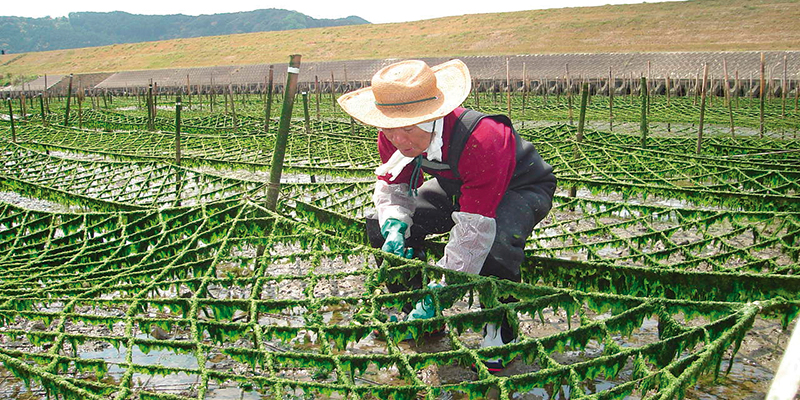
Nori is a favorite food of the Japanese, enjoyed for its flavor and taste, often with Cha (green tea). This simple dry foodstuff processed from the edible red algae Pyropia yezoensis (the former genus name was Porphyra) adds variety to the daily diet and offers flavor, nutrients, and other health benefits. In Japan, the algal product is commonly found in the market as not just a favorite topping but is also included in some traditional rolled dishes such as sushi and various kinds of wrapped rice balls. Nori is widely accepted as a good partner to rice, the staple food in Japan. Here, descriptions of traditional nori foodstuffs are given.
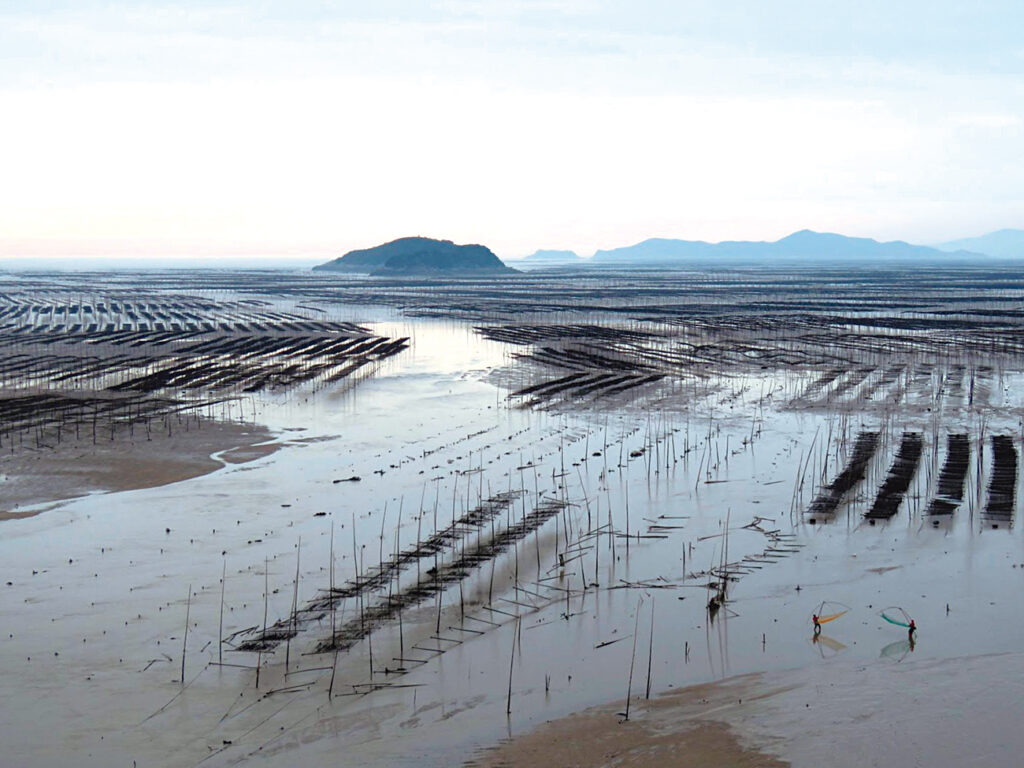
In recent years, the total annual harvest of nori and related seaweeds has been a steady 300,000 tons, based on statistical data from Japanese fisheries (MAFF, 2017). Most nori is produced by aquaculture of the major species, Pyropia yezoensis, in shallow water. By the Edo period, the aquaculture techniques had been established, and nori came to be processed in well-dried and sometimes roasted paper-like sheets measuring 19 cm by 21 cm, or approximately 3 g per sheet, using traditional Japanese techniques for making paper by hand. Today, these processes are automated with specialized machines. The annual production of dried and roasted nori reached 7 billion sheets in 2015 (MAFF, 2017).
Various kinds of seaweed, which contain a number of polysaccharides, vitamins, and minerals, are popular foodstuffs in Japan. Nori is among them, but it has a unique characteristic nutritional profile that sets it apart from other seaweeds. Even more remarkable is that it is a good source of nutrients that are rare in other vegetables and also has unique metabolites with health benefits, as discussed below.
2. Nutrients and Flavors
Common nori is a dried product with less than 3% moisture content and which has protein and dietary fiber as its major components, as shown in Figure 1. It is low fat (3.7%) and is low in digestible carbohydrates (1.9%). Nori is a good source of protein, similar to the protein content in beans. Further, based on the food composition table (MEXT, 2015), nori has features that are different from other seaweeds (wakame, konbu, hijiki, and hitoegusa) or other dried food materials (soybean, tomato, and strawberry), as shown in Table 1. The dietary fiber content of most seaweed is approximately 30%; however, the protein content of nori, at 41.4%, is nearly three times that of other seaweeds. Analysis of the fatty acid (FA) composition (MEXT, 2015) reveals that eicosapentaenoic acid (EPA, or icosapentaenoic acid, IPA, 20:5n-3) is the major FA in dried nori (1200 mg/100 g). It has been demonstrated that some edible seaweeds, especially Porphyra sp., contain high levels of IPA (Dawczynski, 2007). An analytical study of nori from different growing conditions elucidated that nori has a metabolic pathway, which commonly found in animals, from linolenic acid to IPA (Kayama, 1985).
In addition, nori contains high levels of iron, zinc, and manganese (Esashi, 1993; Mišurcová, 2001) as well as high vitamin A (shown as beta-carotene equivalent), vitamin B12, folic acid, and vitamin C content as compared to other foodstuffs (Figure 2). Nori’s vitamin B12 (VB12) content is equal to that found in animal sources such as liver paste. The bioavailability of VB12 from powder has been confirmed in previous animal experiments (Takenaka, 2001), and clinical trials have confirmed the bioavailability and effectiveness of VB12 in numerous nori products. In a study by Suzuki (1995), the addition of 2 to 4 g per day of nori powder to the brown rice-based diets of six young vegans aged 7 to 14 years was effective in preventing a VB12 deficiency. All this indicates that nori is rife with ingredients that are nutritionally beneficial.
Nori in important in Japanese food for not only providing nutrition but also adding flavor to meals, which enhances interest in food and increases appetite, therefore promoting good eating habits.
However, identification and analysis of nutritional components of nori have been difficult, and flavor components of nori have not been perfectly elucidated, but previous reports have revealed some components. For instance, it has been reported that pyrazine, gamma butyrolactone, and several types of hydrogen sulfide (including dimethyl sulfide and methyl mercaptan) are important in creating the flavor of roasted nori products (Osumi, 1990; Kasahara, 1975, 1986). The tastes of foods are also provided by the water-soluble and low-molecular compounds that are extractable from the foodstuff. In this sense, nori contains abundant amino acids such as glutamic acid, aspartic acid, alanine, and taurine, along with nucleic acids such as adenyl acid and inosine acid. These components have a sweet and/or umami taste, but their levels vary according to not only environmental growing conditions and season but also according to the processing and storage conditions of nori products (Harada, 1990). Recently, active deaminase has been purified from dried nori products, and the properties were elucidated (Nakashima, 2000). The deaminase converts from adenyl acid, which is eluted from nori to inosine acid, which is an umami component, under the optimal conditions of 7.0 to 8.0 pH at 30–50˚C in the presence of water and Ca2+. The enzyme has desiccation tolerance, so it also contributes to enhancing the taste of nori when it is chewed. In this way, nori adds a pleasurable smell and taste to daily food intake.
3. Health-promoting Compounds
Various types of seaweed are known to be rich sources of nutrients with low calories that provide a number of health-promoting benefits. Nori also gives us an effective means for balancing our physiological condition through its unique compounds, given the recent discoveries that more ingredients found in foods than previously thought exhibit physiological regulating activities. Some of these components are found in nori, as introduced below.
Porphyran
Dietary fibers found in seaweeds can be classified into several types according to structure and activity which are closely connected to the taxonomic group of the algae (Kim, 2011). In the case of red algae, some kinds of galactan, such as agarose, carrageenan, funoran, and porphyran, are commonly found. In particular, porphyran is observed as a major polysaccharide in nori. The linear polysaccharide is composed of L-galactose (Gal) and D-galactose, with variations, including 6-O-methyl-D-Gal, 6-O-sulfate-L-Gal, and 3,6-anhydro-L-Gal (Morrice, 1983) (Figure 3). The molecular size and sulfation rates of porphyran in nori are subject to environmental factors (Hama, 1998). It is easily dissolved in water and shows high viscosity, but does not turn into a gel.
A wide range of physiological activities of porphyran have been reported, including antioxidative activity (Zhang, 2004), anti-inflammatory activity (Isaka, 2015), inhibitory activity against α-amylase (Goni et al., 2000), antidiabetic activity in KKAy mice (Kitano et al., 2012), suppressive effects on serum cholesterol levels in rat (Tsuge et al., 2004), anti-tumor activity (Noda et al., 1989), apoptosis-inducing activity (Kwon, 2006), anti-allergic activity in mice (Ishihara, 2005), and much more.
The sulfated polysaccharide that can be prepared in large quantities from nori is expected to be used for various product applications.
Mycosporine-like amino acids
Mycosporine-like amino acids (MAA) are derivatives of mycosporine (Favre-Bonvin, 1976) that contain a cyclohexenimine or cyclohexenone ring linked to an amino acid or its metabolites (Figure 4). The compounds having strong absorption maxima in the range of 310 to 360 nm and are widely present in marine plants and animals (Dunlap, 1998). These products are considered to be natural protectors against UV radiation and related lesions. Further research has shown that these products are supplied only by algae, and the marine animals have acquired them through the food chain or symbiotic relationships. Other various actions of MAA that have been reported include antioxidative activities in vitro (Tao, 2008), growth-inducing activity against fibrocytes of human origin (Oyamada, 2008), and UV-protecting activities in fish eyes (Dunlap, 1989). Applications in mammals are also being studied, and UV-protecting activities have been shown in externally applied MAA on mice skin (Coba, 2009). There is not currently enough data on in vivofunctionality of MAA after oral administration to mammals.
Among marine algae, the red algae group is known to be one of the major producers of MAA (Karsten, 1998). Nori contains three major MAAs, mycosporine-glycine, shinorine, and porphyra-334 (Yoshida, 1970), according to pioneering research (Ito, 1977; Takano, 1979). Today, extracts containing these MAAs are used in commercial production of sunscreen and health food products.
Galactosyl glycerols
Galactosyl glycerols (GG) such as floridoside and isofloridoside are the major products relating to osmotic modulation in most red algae (Reed, 1985) (Figure 5). The genus Pyropia also contains floridoside and isofloridoside, with the isofloridoside coexisting in two enantiomeric forms: D-isofloridoside (1-O-a-D-galactopyranosyl-D-glycerol) and L-isofloridoside (1-O-a-D-galactopyranosyl-L-glycerol) (Meng, 1987). Each isomer has been identified with NMR techniques (Bondu, 2008), making comparison possible through instrumental analysis to measure the content of these galactosides in nori according to environmental and seasonal conditions (Karsten, 1999).
Recently, the compounds have been found to have bifidogenic growth stimulator activity, and they are the focus of research as a new prebiotic material. GG-rich mixtures of three isomers have been purified from a 75% MeOH extract of nori to perform animal experiments, and dietary GG was shown to selectively increase the cecal Bifidobacterium count in rats (Ishihara, 2010). Other indices of prebiotics, such as pH of cecal content, organic acid concentrations, and fecal weight, have also supported its prebiotic activity.
Imidazole dipeptides
Anserine and carnosine are known as imidazole dipeptides (Figure 6), which are metabolites consisting of two amino acids, histidine and beta alanine. They are commonly found in fish such as tuna, bonita, salmon, and others and in white meat such as chicken, goose, and turkey. However, only a few kinds of plants contain these peptides. Tamura et al. (1998) have found these dipeptides to act as strong antioxidants in the basic amino acid containing fraction prepared from EtOH extract of nori. The concentrations were calculated as 2.20 mg anserine and 1.60 mg carnosine in 1 g of dried nori, which compares with typical concentrations in chicken (3.57 mg and 1.30 mg/g, respectively) and fresh tuna (9.40 mg and 0.48 mg/g, respectively) (Hiraoka, 2011). These peptides show antioxidant activity in various in vitro assays (Kohen, 1988) and lowered uric acid levels in rats (Chen, 2004). In one study, anserine given at 25 mg per day for 4 weeks improved hyperuricemia in people who need to control uric acid levels (Kubomura, 2009), indicating that an appropriate daily intake of these dipeptides may increase the possibility of preventing hyperuricemia and protect against oxidative stress.
Other components
Among other applications, nori has also been used as a source of organic pigments after semi-purification or as supplement tablets after enzyme treatment.
Dried nori as a food product is nearly black in color, but the red alga P. yezoensis contains pigments of chlorophyll (green), carotenoid (orange), phycoerythrobilin (red), and phycocyanobilin (blue). The bilin pigments having linear tetrapyrrole moiety, constituting phycoerythrin and phycocyanin, respectively, to bind to specific apoproteins. Increasing water activity during storage of nori accelerates the hydrolysis of chlorophyll and phycocyanobilin, finally inducing the color change to reddish black. Alternatively, increasing roasting treatments to bring out flavor denatures heat-labile phycoerythrin, finally inducing a color change to clear greenish black (Fujiwara, 1961). All of these pigments have shown strong antioxidative activity in vitro and in vivo (Yabuta, 2010; Soni, 2009). In the mammal intestine, bilin pigments are easily absorbed into the bloodstream after digestion of the apoproteins by intestinal enzymes. Therefore, these large pigment molecules also appear to exhibit antioxidative activity in vivo.
Nori as a protein source can be utilized for protease treatment or fermentation to create new active components. There have been some trials applying fermentation techniques with nori powder wherein lactic acid fermentation of nori produced gamma amino butyric acid (GABA) that had a suppressive action on blood pressure (Tsuchiya, 2007). Other research groups have reported inhibitory oligopeptides against angiotensin converting enzyme (ACE) after pepsin treatment and semi-purification of nori powder (Suetsuna, 1998). These activities and mechanisms have been confirmed in experiments using SHR rats and in human clinical trials (Saito, 2005). The nori oligopeptides have been applied to foods for specified health uses (FOSHU) product approved by the consumer affairs agency in the Japanese market since 2005. The major active peptide identified in these products from digestive nori material is Ala-Lys-Tyr-Ser-Tyr.
4. Conclusion
This paper has given a brief overview of nori. It is not just a traditional edible seaweed in Japan, but rather, it is also a superfood with a lot of potential for promoting good health. Various unique nutrients and health-promoting ingredients have been found in this food product. Aside from providing energy, this foodstuff enhances appetite and improves health through daily eating habits in Japan. The knowledge gained through continuous research into seaweed and its components will enable development of new ingredients, food materials, and uses of them all over the world.
Seaweed is an important part of the traditional Japanese food culture in promoting good health. We hope that this relationship will continue for a long time into the future.
* Tokyo University of Marine Science and Technology
Literature
S. Bondu, N. Kervarec, E. Deslandes, and R. Pichon
Separation of floridoside and isofloridosides by HPLC and complete 1H and 13C NMR spectral assignments for D-isofloridoside.
Carbohydrate Research 342, 2470–2473 (2007).
J. B. Chen, H. C. Peng, and S. H. Lin
Effects of chicken extract on plasma antioxidative status and lipid oxidation in healthy Rats.
Journal of Nutrition Science and Vitaminology, 50, 320-324 (2004).
F. de la Coba, J. Aguilera, M.V. de Gálvez, M. Álvarez, E. Gallego, F. L. Figueroa, and E. Herrera
Prevention of the ultraviolet effects on clinical and histopathological changes, as well as the heat shock protein-70 expression in mouse skin by topical application of algal UV-absorbing compounds.
Journal of Dermatological Science 55, 161–169 (2009).
C. H. Dawczynski, R. Schubert, and G. Jahreis
Amino acids, fatty acids, and dietary fiber in edible seaweed products.
Food Chemistry, 103, 891–899 (2007).
W. C. Dunlap, D. M. Williams, B. E. Chalker, and A. T. Banaszak
Biochemical photoadaptations in vision: UV-absorbing pigments in fish eye tissues.
Comp. Biochem. Physiol. 93B, 601–607 (1989).
T. Esashi, and M. Hanai,
Bioavailability of magnesium contained in purple laver (Asakusa-Nori) by rats with scarce magnesium, being evaluated from serum magnesium, kidney calcification, and bone magnesium contents.
Journal of Nutritional Science and Vitaminology, 39, 381-387 (1993).
J. Favre-Bonvin, N. Arpin, and C. Brevard
Structure de la mycosporine (P 310).
Canadian Journal of Chemistry, 54, 1105–1113 (1976).
T. Fujiwara
Studies on chromoproteins in Japanese nori, Porphyra tenera. V. on the sugar components of phycoerythrin.
J. Biochem., 49, 361-367 (1961).
I. Goni, L. Valdivieso, and A. Garcia‐Alonso
Nori seaweed consumption modifies glycemic response in healthy volunteers.
Nutrition Research, 20, 1367-1375 (2000).
Y. Hama, H. Nakagawa, M. Kurosawa, T. Sumi, X. Xia, H. Hatate
A gas chromatographic method for the sugar analysis of 3,6-anhydrogalactose-containing algal galactans.
Analytical Biochemistry 265, 42-48 (1998).
K. Harada, Y. Osumi, N. Fukuda, H. Amano, and H. Noda
Changes of amino acid compositions of ‘Nori’ products, Porphyra spp. during storage.
Nippon Suisan Gakkaishi 56, 607-612 (1990).
Y. Hiraoka, Y. Sasaki, and K. Sonoda
Investigation of Contents of Nitrogenous Constituents in the Extracts of seafood caught in Ehime (Part1) (in Japanese).
Ehime Prefectural Industrial Technology Research Institute report, 48, 19-22 (2011).
S. Isaka, K. Cho, S. Nakazono, R. Abu, M. Ueno, D. Kim, and T. Oda
Antioxidant and anti-inflammatory activities of porphyran isolated from discolored nori (Porphyra yezoensis).
International Journal of Biological Macromolecules, 74, 68-75 (2015).
K. Ishihara, C. Oyamada, R. Matsushima, M. Murata, and T. Muraoka
Inhibitory effect of porphyran, prepared from dried “nori”, on contact
hypersensitivity in mice
Biosci. Biotechnol. Biochem., 69, 1824–1830 (2005).
K. Ishihara, C. Oyamada, Y. Sato, T. Suzuki, M. Kaneniwa, H. Kunitake, and T. Muraoka
Prebiotic effect of glycerol galactoside isolated from color-faded nori in rats.
Fisheries Science, 76, 1015-1021 (2010).
S. Ito, and Y. Hirata
Isolation and structure of a mycosporine from the zoanthidian Palythoa tuberculosa.
Tetrahedron Letter, 28, 2429–2430 (1977).
U. Karsten, T. Sawall, and C. Wiencke
A survey of the distribution of UV-absorbing substances in tropical macroalgae Phycological Research, 46, 271-279 (1998).
U. Karsten
Seasonal variation in heteroside concentrations of field-collected Porphyra species (Rhodophyta) from different biogeographic regions.
New Phytology, 143, 561–571 (1999).
K. Kasahara, J. Funakoshi, and K. Nishibori
Identification of volatile components of roasted laver by GC-MS analysis
Bulletin of the Japanese Society of Scientific Fcisheries 52,751-754 (1986).
K. Kasahara, and K. Nishibori
Flavoring volatiles of roasted laver-I
Bulletin of the Japanese Society of Scientific Fisheries 41, 193-199 (1975).
M. Kayama, N. Iijima, M. Kuwahara, T. Sado, S. Araki, and T. Sakurai
Effect of water temperature on the fatty acid composition of Porphyra.
Bulletin of the Japanese Society of Scientific Fisheries, 51, 687-691 (1985).
Y. Kitano, K. Murazumi, J. Duan, K. Kurose, S. Kobayashi, T. Sugawara and T. Hirata
Effect of dietary porphyran from the red alga, Porphyra yezoensis, on glucose metabolism in diabetic KK-Ay mice.
Journal of Nutritional Science and Vitaminology, 58, 14-19 (2012).
R. Kohen, Y. Yamamoto, K. C. Cundy, and B. N. Ames
Antioxidant activity of carnosine, homocarnosine, and anserine present in muscle and brain.
Proc. Natl. Acad. Sci. USA., 85, 3175-9 (1988).
D. Kubomura, Y. Matahira, A. Masui, and H. Matsuda
Intestinal absorption and blood clearance of L-histidine-related compounds after ingestion of anserine in humans and comparison to anserine- containing diets.,
J. Agric. Food. Chem., 57, 1781-1785 (2009).
M. J. Kwon, and T. J. Nam
Porphyran induces apoptosis related signal pathway in AGS gastric cancer cell lines.
Life Science 79, 1956–1962 (2006).
MAFF: Ministry of Agriculture, Forestry and Fisheries, Japan
The 91th Statistical Yearbook (2017) of MAFF Japan
http://www.maff.go.jp/e/tokei/kikaku/nenji_e/nennji_index.html
J. Meng, K. G. Rosell, and L. M. Srivastava,
Chemical characterization of floridosides from Porphyra perforata.
Carbohydrate Research, 161, 171–180 (1987).
MEXT: Ministry of Education, Culture, Sports, Science and Technology, Japan
Standard Tables of Food Composition in Japan 2015 (7th revised edition in 2015)
http://www.mext.go.jp/en/policy/scie nce_technology/policy/title01/detail0 1/1374030.htm
L. M. Morrice, M. W. McLean, W. F. Long, and F. B. Williamson
Porphyran Primary Structure.
European Journal of Biochemistry, 133, 673-684 (1983).
A. Nakashima, T. Sakurai, K. Inui, and S Araki
The occurrence and properties of 5’-AMP deaminase in dried and toasted nori
Fisheries Science 66, 110–116 (2000).
H. Noda, H. Amano, K. Arashima, S. Hashimoto, and K. Nishizawa
Antitumour activity of polysaccharides and lipids from marine algae.
Nippon Suisan Gakkaishi, 55, 1265-1271 (1989).
Y. Osumi, K. Harada, N. Fukuda, H. Amano, and H. Noda
Changes of volatile sulfur compounds of ‘Nori’, Porphyra spp. during storage
Nippon Suisan Gakkaishi 56, 599-605 (1990).
C. Oyamada, M. Kaneniwa, K. Ebitani, M. Murata, and K. Ishihara
Mycosporine-like amino acids extracted from scallop (Patinopecten yessoensis) ovaries: UV Protection and Growth Stimulation Activities on Human Cells.
Marine Biotechnology, 10, 141-150 (2008).
R. H. Reed
Osmoacclimation in Bangia atropurpurea (Rhodophyta, Bangiales): the osmotic role of floridoside.
British Phycological Journal, 20, 211-218 (1985).
M. Saito, and H. Hagino
Antihypertensive effect of oligopeptides derived from Nori (Porphyra yezoensis) and Ala-Lys-Tyr-Ser-Tyr in rats.
Journal of Japanese Society of Nutrition and Food Science 58, 177-184 (2005).
B. Soni, N. P. Visavadiya, and D. Madamwar
Ameliorative action of cyanobacterial phycoerythrin on CCl4-induced toxicity in rats.
Toxicology, 248, 59-65 (2008).
B. Soni, N. P. Visavadiya, and D. Madamwar
Attenuation of diabetic complications by C-phycoerythrin in rats.
British Journal of Nutrition, 102, 102-109 (2009).
K. Suetsuna
Purification and identification of angiotensin I-converting enzyme inhibitors from the red alga Porphyra yezoensis.
Journal of marine biotechnology 6, 163-167 (1998).
H. Suzuki
Serum vitamin B12 levels in young vegans who eat brown rice.
J. Nutr. Sci. Vitaminol., 41, 5877-594 (1995).
S. Takano, D. Uemura, and Y. Hirata
Isolation and structure of a 334 nm UV absorbing substance, porphyra-334 from the red algae Porphyra teneraKjellman.
Chemistry Letters 26, 419–420 (1979).
S. Takenaka, S. Sugiyama, E. Ebara, K. Miyamoto, Y. Abe, F. Tamura, S. Watanabe, S. Tsuyama, Y. Nakano
Feeding dried purple laver (nori) to vitamin B12-deficient rats significantly improves vitamin B12 status.
British Journal of Nutrition, 85, 699-703 (2001).
Y. Tamura, S. Takenaka, S. Sugiyama, and R. Nakayama
Occurrence of anserine as an antioxidative dipeptide in a red alga, Porphyra yezoensis.
Bioscience, Biotechnology, and Biochemistry, 62, 561-563 (1998).
C. Tao, T. Sugawara, S. Maeda, X. Wang, and T. Hirata
Antioxidative activities of a mycosporine-like amino acid, porphyra-334
Fisheries Science, 74, 1166–1172 (2008).
K. Tsuchiya, S. Matsuda, G. Hirakawa, O. Shimada, R. Horio, C. Taniguchi, T. Fujii, A. Ishida, and M. Iwahara
GABA production from discolored laver by lactic acid fermentation and physiological function of fermented laver. (In Japanese)
Food preservation science, 33, 121-125 (2007).
K. Tsuge, M. Okabe, T. Yoshimura, T. Sumi, H. Tachibana, and K. Yamada
Dietary effect of porphyran from Porphyra yezoensis on growth and lipid metabolism of Sprague-Dawley rats.
Food Science and Technology Research, 10, 147–151 (2004).
Y. Yabuta, H. Fujimura, C. Shilkwak, T. Enomoto, and F. Watanabe
Antioxidant Activity of the Phycoerythrobilin Compound Formed from a Dried Korean Purple Laver (Porphyrasp.) during in Vitro Digestion
Food Science and Technology Research, 16, 347-351 (2010).
T. Yoshida and P. M. Sivalingam
Isolation and characterization of the 337mµ UV-absorbing substance in red alga, Porphyra yezoensis UEDA
Plant & Cell Physiol., 11, 427-434 (1970).
Q. Zhang, N. Li, X. Liu, Z. Zhao, Z. Li, and Z. Xu
The structure of a sulfated galactan from Porphyra haitanensis and its in vivo antioxidant activity.
Carbohydrate Research, 339, 105-111 (2004).
Natural 1